Blog

Gordon Skene Gordon Skene

Stirlingshire, Revisited

Two weeks, eight days, a lot of miles and more laybys than I care to count. The Screen Scotland database refresh took me across Stirlingshire with a camera and a list – familiar ground, seen with fresh eyes.
Stirlingshire, Revisited

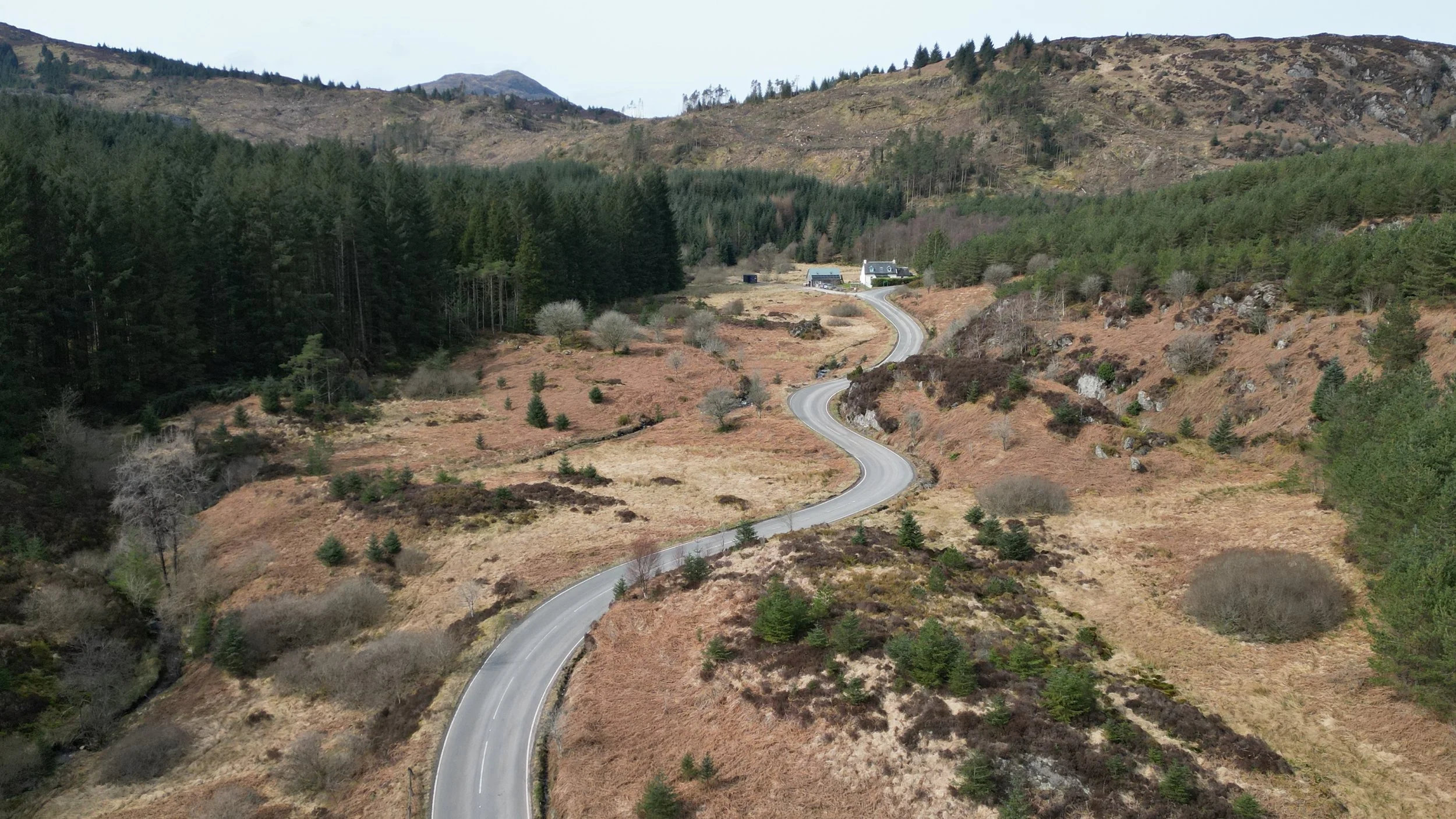
The past couple of weeks I've been doing exactly the kind of job that reminds you why you got into this in the first place. No director to keep happy, no tech recce bearing down on the calendar, no deals to close by end of week. Screen Scotland asked me to work through a list of existing and potential locations across Stirlingshire, photograph them thoroughly, and update their database records. Low stakes, high autonomy. Just a list of places, a full tank, and the instruction to go and look at things carefully. The sort of gig where you remember that the job, at its core, is just paying close attention to places.

Before any of that, though, there's the planning. Anyone who thinks location work begins when you get out of the car hasn't done location work. The first job is to sit down with the list, a map, and a large coffee, and try to construct a route that makes geographical sense, allows a reasonable amount of time at each stop, and accounts for the real-world wrinkles – appointments at private addresses, locations that need advance notice, the places where you simply can't predict how long you'll need until you're standing in them. It's a mild form of plate-spinning, and the plates are all slightly different sizes and spinning at different speeds.

My eight days spread across two weeks ended up looking like this: Stirling city on foot first, then a sweep through Dunblane, Bridge of Allan, Gargunnock and Kippen, then Doune, Deanston, Buchlyvie, Balfron, Fintry and Carronbridge. Then the estates – Keir & Cawder, Touch – then south to Drymen and Rowardennan, then into the Trossachs proper: Aberfoyle, Duke's Pass, Duchray Castle, Loch Achray, Brig o' Turk, Callander. A final day up through Balquhidder and on to Tyndrum. Eight days, a lot of miles, and more laybys than I care to count.

The villages develop their own rhythm after a day or two. Spot a place to leave the car that won't annoy anyone or compromise the shot. Do an up-and-back of the main street, clocking the best angles, the most useful vantages, mentally framing out the ugly road signs and the unfortunate shopfront with the temporary signage. Try to present a fair and truthful version of the place while also making it look its best – which is most of what location photography is, really.

People are their own challenge. Occasionally a figure in the middle distance gives a shot useful scale. More often, they're just in the way. You wait. You frame up. The light is right, the street is clear, the charming period post office is sitting there looking exactly as it should. Nearly there. Nearly. Oh good, she's nearly out of the frame. Nearly. And then a large white delivery van swings into the foreground and parks with great hubris directly in front of everything interesting.

Another reliable feature of the day is the search for decent coffee and lunch. I'll be honest: not every town in Stirlingshire has cracked this yet. Aberfoyle in particular – a gateway to the Trossachs, surrounded by some of the most beautiful scenery in central Scotland – is crying out for a decent deli or takeaway café. The people of the Trossachs deserve focaccia. I'm putting it out there.

Duchray Castle came first that day – a beautiful spot tucked into a part of the Trossachs you'd only find if you went looking. Private land, so you’d have to go looking for it, and have a reason to be there, though at least that means I essentially had it to myself. The owner met me at the gate and turned out to be easy, friendly company. We walked the grounds together: varied terrain, mature woodland, open pasture, and at the end of it, a lovely old castle building wearing its age well. The kind of morning that fits neatly into the mental file marked "good days to be a location scout."

Duke's Pass that afternoon – one of those roads that demands to be experienced rather than just used, the kind where you find yourself slowing down not because you have to, but because it would be a waste not to. The day was clear and bright, the tourist season not yet properly underway, the road quiet save for the odd motorbike threading through, which I'll admit I watched with some envy from four wheels.

The final morning turned dramatic. The weather had been closing in around Balquhidder since early, and I spent the last hour of the scout in a quiet race against it, watching the murk advance down the glen through my lens, trying to get the shots I needed before the visibility dropped and the rain arrived. There's something oddly clarifying (and thoroughly saturating) about that situation, you stop deliberating and just shoot. The added drama of the big black clouds almost makes up for the wet jeans. How come I always leave my waterproofs in the car? How come “I’ll only be a minute” always turns into “how did the car get to be half an hour away from me?”

I've already covered a lot of the ground in Stirlingshire in the past, either through other jobs or just recreational exploration. There's one bit of woodland in particular I was keen to revisit, which sits on an estate where I spent many weeks over the course of several years, working on Outlander. There was a significant set built there, a proper semi-permanent construction that became a familiar backdrop across multiple seasons. I know that wood in a way that most people never get to know a place: in summer and deep winter, in fog and frost, in the quiet of a locked-down pandemic morning when my job was simply to drive out there weekly and make sure everything was still standing.

I remember bitterly cold mornings, the ground frozen solid, sliding on icy aluminium unit base panels in the half-dark, throwing out salt by hand, sweating through thermals while the walkie crackled with competing demands. The particular physical memory of putting my back out one morning heaving temporary track matting into position before the trucks arrived. You carry those things in your body long after the production has wrapped and moved on.

There's been extensive logging since then. The wood looks different now, unfamiliar in places, and I find myself spending longer here than the schedule strictly allows, trying to retrace old paths, match the current landscape to the one I remember. I'm aware I'm on the edge of a nostalgia trip and I should probably keep moving.

And then I find it, or something better. Just below the area I'd been searching, a small gulley in full spring bloom. A burn cutting through wild garlic and bluebells, an old pine leaning low and cinematic over a small waterfall. I startle three roe deer who hold their ground for a moment, weighing me up, then take off up the far slope with much urgency, glancing back as if mildly put out.

I stand there for a few minutes and let the place be quiet around me.

Then I check the time, think about lunch, and get back in the car.

Read More
Gordon Skene Gordon Skene

The Edge of the Map

In June 2023 I was sent out alone to find a small coastal town somewhere on the west or north coast of Scotland. Two weeks, my own car, and one of the finest early summers in recent memory. It's rarely that simple.
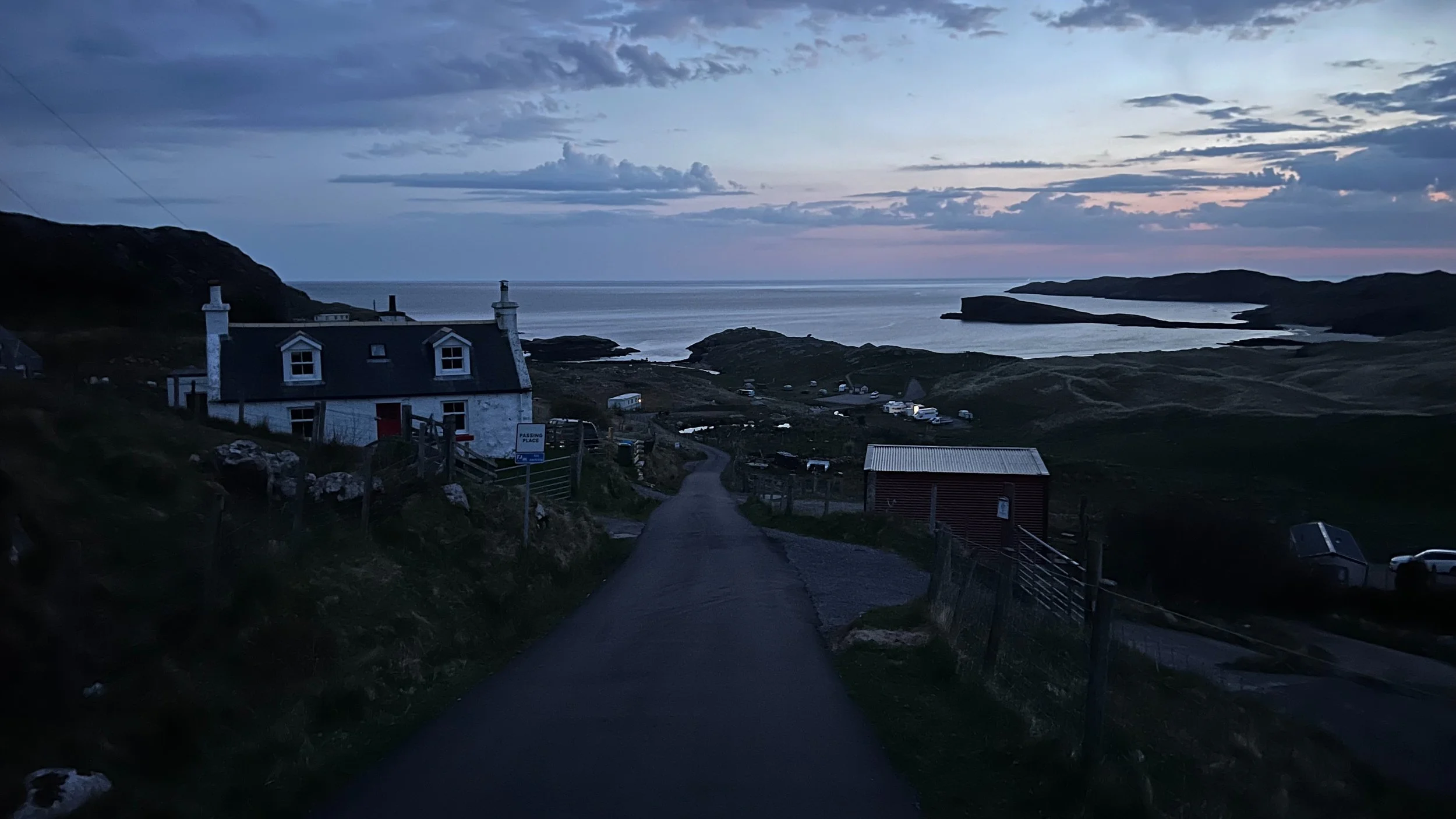
In June 2023 I was given a brief that seemed, on the face of it, achievable: find a small, rural coastal town somewhere on the west or north coast of Scotland. Dramatic, quintessentially Scottish, with a specific geographical relationship between its buildings and the water that the plot demanded. The production was a remake of a Norwegian drama, so something in that northern European coastal vein, but distinctive enough to justify making it at all. I was fairly confident there must be something up there that would fit the bill. There usually is. It's rarely that simple.

I was given two weeks, sent out alone, and took my own car, which at least meant I had everything I needed in the boot: jackets for all weathers, paper maps, binoculars, spare boots, a camping towel. It happened to coincide with one of the finest early summers Scotland has produced in recent memory. I have been luckier in this job than I probably deserve.

The first week was, without overstating it, close to perfect. The west coast in a heatwave is a different country entirely. The light does things it has no business doing this far north, the water turns colours you'd more readily associate with somewhere considerably nearer to a tropic, and the roads are quiet enough that you can stop wherever you like and just stand there for a while. Which, conveniently, is also the job.

The script featured a surfer as one of the main characters, which presented certain professional obligations. Machrihanish, Camusdarach, Big Sands at Gairloch – all required thorough assessment, ideally from the water. Due diligence demanded it. I am nothing if not thorough.

The evenings were their own reward. I love an overnight on a scouting trip in a way that probably says something unflattering about my domestic situation. Per diems liberating you from the tyranny of sensible choices, the laptop open on the dinner table at half eight, uploading the day's photos on whatever passes for broadband in the highland village you've landed in, a glass of something red making the process considerably more bearable. A long day's work. The lamb was excellent.

One evening early in the trip, the first or second night I think, I was driving at a clip to make dinner at a guesthouse with a good local reputation. I called ahead and was told, apologetically, that the chef wasn't available that evening. He was hosting a folk night at the inn a few miles down the road. The front door of the guesthouse would be left unlocked. My room, the big one on the first floor with the bay window, would be ready. Nobody else would be in. Just come to the inn, he said, and I'll hand over your key.

I drove to the inn. Reels were spilling out the door as I walked up. I checked in, in the loosest sense of the words, across a pub table, key changing hands between tunes. The fish and chips were exceptional. I sat there for a while and felt very glad to be alive.

The brief had specific geographical requirements. The plot needed certain buildings in certain relationships to the water, which meant that the pleasant business of driving beautiful coastal roads was also accompanied each evening by hours bent over maps and satellite images, scanning the following day's coastline for anything that might fit the parameters. You develop an eye for it. You learn to read a bay from above and know, before you've driven the road, whether it's worth stopping or not. You're wrong often enough to keep it interesting. I came close a few times, there were moments where I thought I'd nailed it, but it's rarely the places where you feel certain that end up getting chosen. That's just how it goes.

The director, producer, script editor and writer joined for a five day scout midway through. The four of us in one car, winding along back roads, playing guessing games as the light faded and the evening's hotel got closer. On the last night we stayed at Kylesku Hotel, a beautiful spot beneath the iconic bridge, in about as remote a setting as you can find with a functioning kitchen and a wine list. The weather had been building all day into something dramatic and moody and magnificent. I think the Londoners thought they'd landed on another planet. We ordered champagne. It felt appropriate.

I was stood down for a month or two after that first phase, long enough to go and shoot a Cadbury's commercial in the interim, which felt like a fairly significant gear change, and then sent back out for another couple of weeks, followed by another director's recce. We still hadn't found the one. We'd covered an enormous amount of ground and the parameters hadn't shifted. I think I've now driven every inch of road up the length of the west and north coast. A particular highlight, if that's the word, is what's known locally as the wee mad road, the stretch between Lochinver and just south of Kylesku. It's not just a clever name. Stunning all the way round, genuinely vertiginous in places, with small secret communities tucked into enclaves along the route that you'd never find unless you were specifically looking, or specifically lost. Dropping into some fairytale bay as the sun goes down over the Atlantic, often not a soul around. Occasionally a friendly local to break things up, who'll tell you more about the land and the people and the history of a place in ten minutes than you'd find in any guidebook, and who may, if you ask the right questions in the right way, tell you a thing or two about who owns what.

When the production designer joined, a pragmatic, gentle German chap who was both suitably appreciative of the scenery and, reassuringly, quietly terrified by the scale of the task in front of us, things got interesting. We still hadn't found a single location that ticked every box. Ideas that would have seemed absurd at the start of the process were beginning to sound almost reasonable. Building part of the set into a remote cove. Constructing a larger house around an existing cottage. Piecing the story's geography together from two entirely separate locations.

In the end, that last option is more or less what we did. Part of it in Kinlochbervie. Part of it on Mull. The director, to his credit, acknowledged on the first day of tech recces that this was somewhat insane. We pressed on regardless.

I'd encountered Oldshoremore and the Kinlochbervie area during the initial scout, but it was only once we committed to it as a location that I really got to know that corner of the country. And it got under my skin in a way that very few places have.

Oldshoremore is one of a handful of beaches up there that are genuinely, almost unreasonably beautiful, the kind of empty, vast, quietly spiritual places that make you feel like you've arrived somewhere the rest of the world forgot to find. On that first visit it was bathed in June sun. On later visits there were storms that turned the whole landscape into something almost biblical. Both versions were extraordinary.

I was up there for much of January and February 2024 doing tech recces, and then moved up more or less full time from March through to the end of May for the shoot. I found a small cottage just above the beach, tiny, rustic, open fire, solitude, and a view that made all of it entirely acceptable. After a couple of weeks the owner vacated the larger cottage next door and I was able to move in. A sun-room overlooking the beach. A walkie-talkie on the dining room table, paperwork in front of me, the set visible from the window. On one or two occasions I watched the shoot unfold from the breakfast table while simultaneously chasing a signature on a location agreement. The commute was one minute.

The community up there took us in. A small, tight-knit place where everyone knows everyone and strangers are assessed with a careful eye before being admitted to any degree of warmth. The local shopkeeper, the harbourmaster, initially presenting as a formidable old salt, later revealed once the ice thawed to be generous and kind, the bar staff in the two pubs that serve the surrounding thirty mile radius. You get to know people quickly when the social geography is that concentrated.

There was, it's fair to say, one notable exception to the welcome, a certain large local estate whose factor made it comprehensively clear that they had no interest in our money, our crew, or our cameras, and that we would not be setting so much as one toe on their land. I'll leave it there.

I've spent time in the Highlands before, but not that part of them. It sits so far north that it feels more like the islands, the pace is different, the light is different, the relationship between people and land and weather is different. For the London crew it was another world entirely. For me it was a recalibration. There's no supermarket for hours, so the weekly shop becomes a half-day expedition. The weather sets the terms, not you, and the sooner you accept that the better. But once you find the rhythm of it, it really does get into your blood.

I didn't want to leave when it was over. I still have dreams about it, occasionally. Come to think of it, I'm long overdue a visit.

Read More
Gordon Skene Gordon Skene

What Location Management Actually Is

Everyone assumes location management is just travelling around finding beautiful places. It is, for about a third of the time. The rest is permits, parking, and the shitty stick.
Tell someone you work in film and TV locations and you'll see it happen in real time. Their eyes light up. "Oh wow, so you just... travel around finding amazing places?" Well. Yes and no.

The scouting part of the job is exactly as good as it sounds. You're out on the road, pulling over at laybys and farm tracks, building a mental map of the country one interesting stranger and unexpected view at a time. There's also the access question, which is one of the genuine perks. The job takes you places most people never get to see: private manor houses, the inner chambers of government buildings, towers with breathtaking views high above the city. Half the fun is playing detective to get there in the first place, tracking down who owns a particular patch of land, who sits on which committee, whose name is at the bottom of the deeds. And then, remarkably, most people just... let you in. On your word. Often while helpfully mentioning when they'll be in and when they won't. It's a good job I'm so honest and trustworthy. It's genuinely brilliant work and I won't pretend otherwise. But it's roughly a third of the job, if that. What comes after is where things get more complicated.

Once you've found your locations, the role shifts. Suddenly you're a negotiator, drafting agreements with landowners, talking money with farmers and estate managers and council officials, trying to find a number that works for everyone. You're also, somewhere along the way, expected to hold your own in conversations about civil engineering, planning law, arboriculture, tidal patterns and coastal access rights, conservation regulations, the archaeological significance of a particular patch of ground, and – for reasons that remain unclear – hold a working knowledge of ancient Aramaic history and cryptology. You learn to absorb this stuff fast, or at least to act like you have. Next you become a logistics coordinator, mapping out unit bases, arranging parking for forty-odd trucks and sometimes hundreds of cars, organising equipment access, drawing up site plans. Then you're a compliance officer, obtaining permits from local authorities, liaising with police, notifying residents, ticking every box before a camera is anywhere near the place. Then, finally, somewhere in there, you're also dealing with the bins. And the toilets.

O, the toilets.

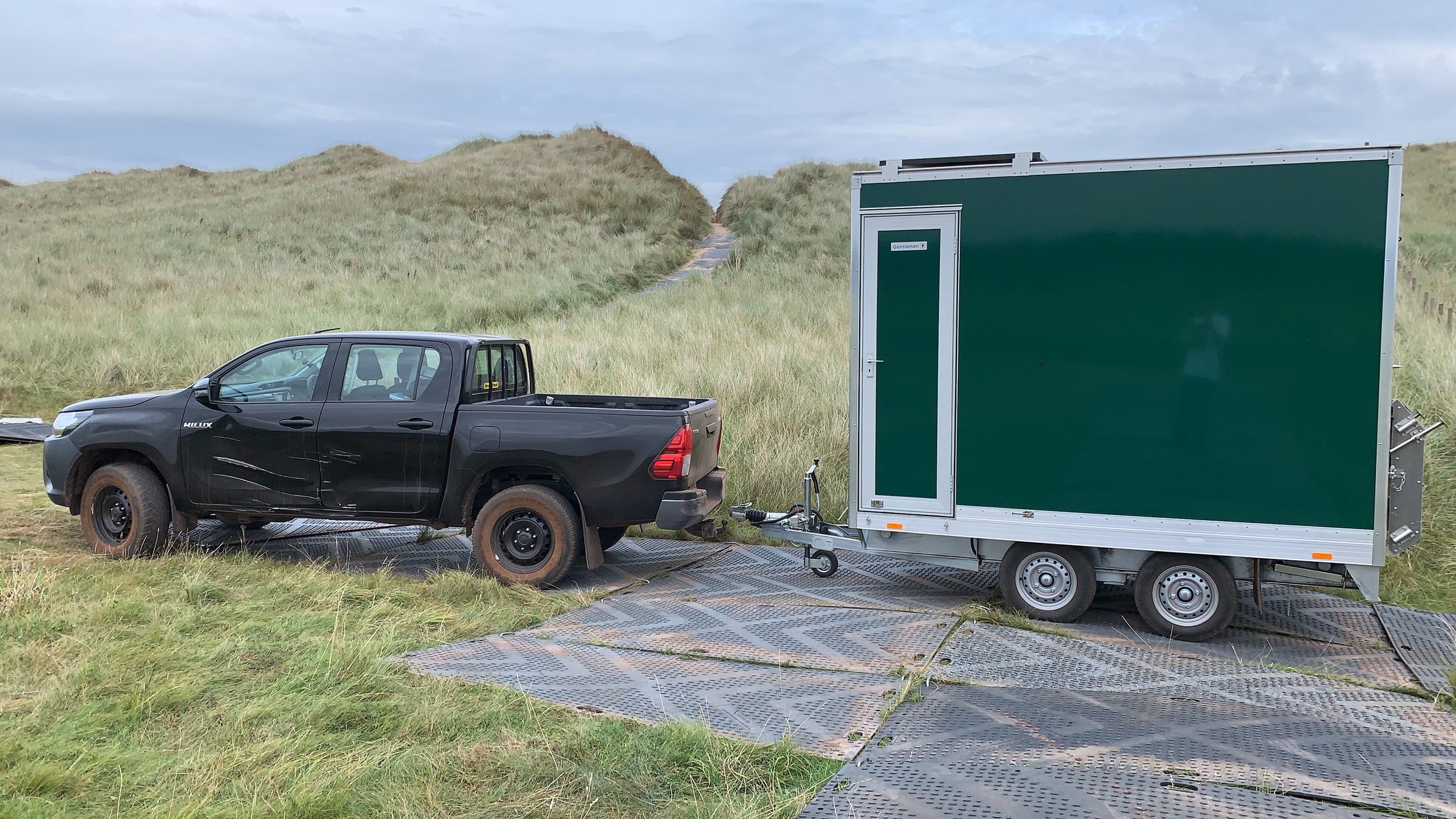
On larger productions, we use what are rather sweetly known as ‘honeywagons’ – essentially luxury toilet trailers, which sounds grand until one gets blocked, which they do, regularly, because people treat them exactly as you'd expect people to treat a toilet they don't own. When that happens, someone has to deal with it. That someone is usually the most junior member of the locations team, armed with what is known, with a mixture of affection and dread, as the shitty stick. Sometimes a broom handle, sometimes – if you're shooting in the wilds – a branch or twig sourced from the nearest hedgerow. Every location manager worth their salt has, at some point in their career, either wielded the stick themselves or dispatched someone else to do so. It is a rite of passage. It is not glamorous. It is very much part of the job.

The other thing nobody tells you about is the arc of your status over the course of a production. During the scouting phase, you're practically joined at the hip with the director and the DOP. Long days on the road together, dinners at the end of them, the easy camaraderie of a small team working towards something. You know each other's coffee orders. You finish each other's sentences about what the perfect location looks like.

Then the tech recce arrives and suddenly there are forty people where there were four. More departments, more heads of department, more opinions. Oh, they still need you alright. For now. Someone’s got to find a way to convince the pensioner neighbour to let them position a 10,000kW lamp in their back bedroom for a week, after all.

By the time the shoot itself rolls around, the director has a full entourage and approximately eight hundred things on their mind, none of which are you. I'm not crying. It's just been raining on my face.

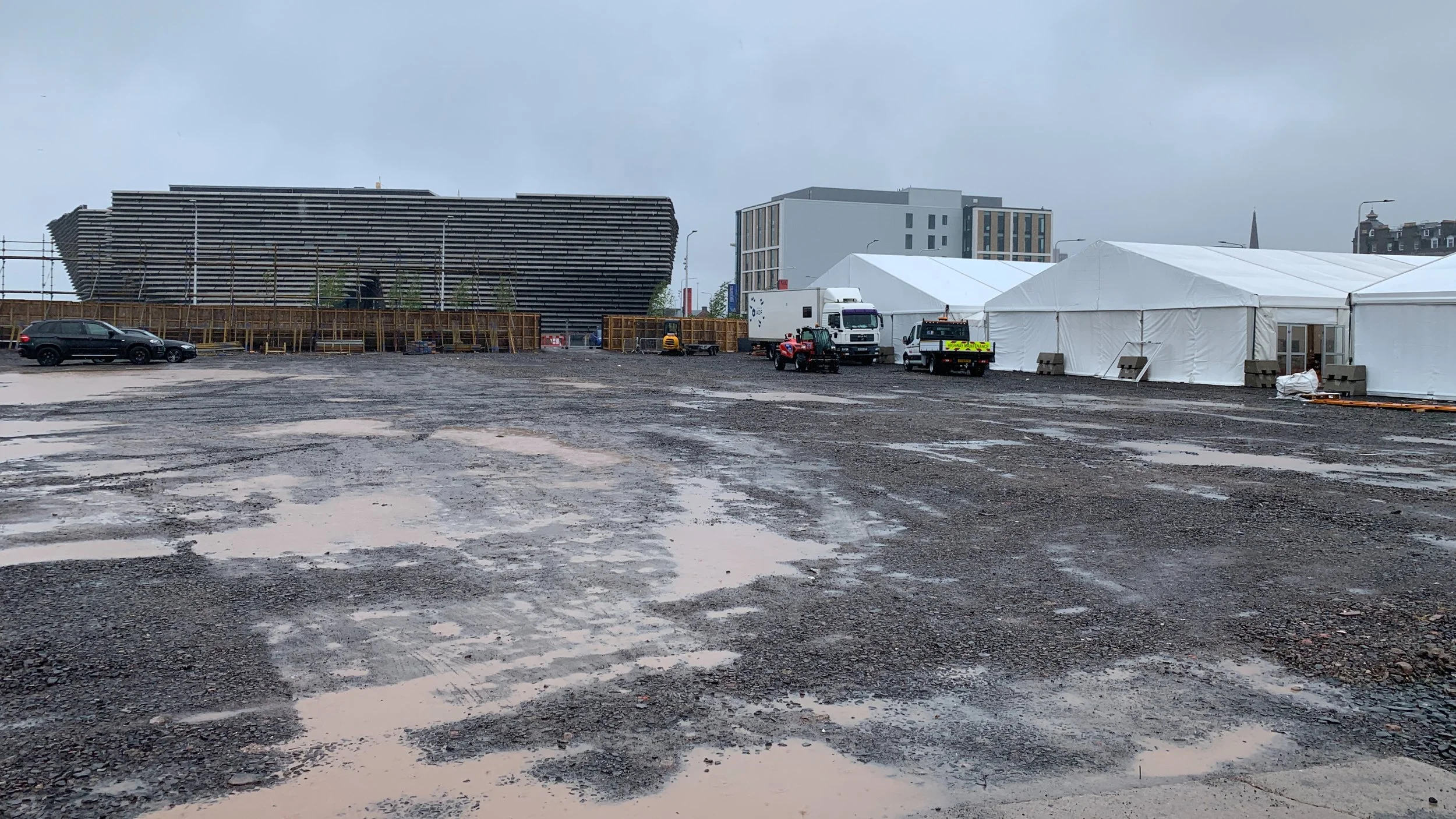
You, meanwhile, are standing in a rain-soaked temporary car park at six in the morning, egg running down your chin, half-eaten breakfast roll in one hand, walkie-talkie in the other, wearing what can only be described as a functional disguise – hat pulled down, three jackets, waterproof trousers, wellies, pockets distended with tools and tape and bits of signage and a flask and a map and a contract you need to chase someone to sign. You look like a man who has given up on the concept of appearance, which is partly by necessity and partly, let's be honest, because nobody is looking at you anyway.

The silver car pulls up. The director steps out, immaculate, fresh from the good hotel, wearing the kind of effortlessly expensive outdoor gear that suggests they've never actually been outdoors in anger… hang on where was that gear on the recce? How come you had to drive the bus right to the end of the pier? They walk straight past you without a flicker of recognition.

You wave them through to set. They nod vaguely at a point somewhere above your left shoulder.

This is fine. This is the job. You were never in it for the glory.

Though it would be nice, occasionally, to be in it for a slightly better breakfast roll.

Read More
Gordon Skene Gordon Skene

Scotland's Bigger Picture

There's an unwritten rule in Scottish film and TV production: stay within an hour of Glasgow or Edinburgh. It's understandable. It's also leaving a lot of great locations sitting unused.
Scotland's Bigger Picture

There's an unwritten rule in Scottish film and TV production: stay within an hour of Glasgow or Edinburgh. Preferably less. It actually is written down fairly often, in briefing emails from producers – but you feel it too in the early conversations on almost every project, that gentle gravitational pull back towards the central belt, the slight unease when locations start appearing on the map that require an overnight stay.

I understand it. I do. Crew are based in Glasgow and Edinburgh. Kit hire companies, studios, production offices – all of it is anchored to those two cities. Every mile you move away from them adds cost, complexity and time. For a smaller budget production, that calculus can be genuinely prohibitive, and I'm not going to pretend otherwise.

But Scotland is a big small country, and a lot of it barely gets looked at.

Take Inverness. It has an airport with direct flights from London, decent rail connections, and sits within reasonable reach of some of the most cinematically varied landscape in Europe. The coast north towards the Black Isle and Dornoch is quietly stunning – not the dramatic, rocky west coast that productions tend to reach for, but something more subtle and interesting for it. Head east along the Moray coast towards the fishing villages of Buckie, Cullen and Portknockie and you're in genuinely distinctive territory. Whisky Galore was filmed along that stretch, and it's easy to see why – there's a texture there, a working coastal character, that's hard to manufacture anywhere else.

Then there's the eastern side of the Cairngorms, which tends to get overlooked in favour of the more familiar highland postcard on the other side. It's a different landscape entirely – ancient forest, moorland, a quality of light that feels almost Scandinavian at times. Interesting, versatile, and not yet worn smooth by overuse.

The doubling question is worth addressing, because it's complicated. Finding a location close to Glasgow that can convincingly stand in for somewhere more remote is genuinely satisfying when it works – there's a craft to it, and it solves real logistical problems. The old back road between Largs and Greenock gets used regularly for island doubling, and fair enough, it earns it. You can absolutely tell the Campsies from Sutherland if you know what you're looking at, but plenty of audiences don't, and that's fine.

What's less fine is when the geography stops making sense altogether. A recent example involved a production with a highland storyline where the remote village in question appeared to be a comfortable couple of hours from Edinburgh, and didn't look particularly highland or remote either. The Scottish audience clocks that immediately – not out of pedantry, but because place matters to a story. Treat locations as interchangeable backdrops and the narrative starts to feel unmoored, even if viewers can't quite put their finger on why.

The solution isn't always to travel further and spend more overall. But there's a reasonable case for shifting where in the budget that money goes. A bit more at the scouting stage – an extra day on the road, an overnight or two – can surface locations that do the job properly first time. That saves it elsewhere: in the production design budget trying to dress a location into something it isn't, in the edit trying to cut around the bits that don't convince, or in the quiet embarrassment of hoping the audience doesn't look too closely.

They usually do.

Read More
Gordon Skene Gordon Skene

From the Stage to the Scout Car

I spent ten years as a professional musician before stumbling into location management. Turns out the two jobs have more in common than you'd think.

People sometimes ask how I ended up in location management. The honest answer is: by accident, and with some relief.

I spent ten years as a professional musician. After leaving school in 2002, a few of us moved to Glasgow with the fairly ambitious plan of making a go of it. The city had an extraordinary music scene at the time and it swallowed us whole, in the best possible way. My first band with a recording contract was called Make Model, and we signed to EMI during what felt like a genuine moment of momentum. Bidding wars, tastemaker press, small tours. Then we imploded mid-album, as bands do, and that was that.

After a stint doing session work, which I loved, honestly, for the sheer lack of responsibility, I was asked to join Frightened Rabbit, who were already one of my favourite Scottish bands and had built a real following, particularly in the US. We signed with Atlantic and Domino, toured extensively, recorded together. It was an incredible few years. But living and working in each other's pockets with four other people for that long takes its toll, and in 2014 I stepped away.

I needed a job. A friend worked in commercials production and got me on set as a runner. The on-set atmosphere struck me immediately, and not entirely favourably. Coming from the music industry, which for all its chaos is comparatively relaxed and unstuffy, and, strange as it sounds, far less ego-driven than life on a film set, the world of assistant directors and their clipboards felt unnecessarily tense. A lot of stress performed very loudly by people who seemed to enjoy performing it. I don't think I hid my feelings particularly well, because before long my friend pulled me aside and asked if I'd like to go and photograph a potential location instead.

I said yes before she'd finished asking.

What I didn't expect was how much my background in music would shape the way I work. Not in any literal sense – nobody needs a bassist on a recce – but in the way I think about creative collaboration.

Spending a decade working closely with directors, producers and other musicians taught me that the process matters as much as the result. That the best work tends to come when people feel understood, when there's enough trust in the room to say "actually, that's not quite it" and try again. You learn to read people. You learn when to push an idea and when to let it go.

That instinct transfers directly to location work. A big part of the job – the part that doesn't show up on any call sheet – is time spent with directors and production designers, getting inside their heads. Hours in the car between locations. Dinner at the end of a long recce day. Those conversations are where you find out what a project is really about, what the director is reaching for, what keeps the production designer up at night.

I remember sitting with a director over aperitifs in a hotel somewhere in the north-west, trying to pin down a location we'd been circling for weeks. We were drawing rough sketches on scraps of paper, pulling up maps on phones, scrolling through reference images, trying to articulate why this specific type of place seemed to exist everywhere except Scotland. It felt a bit like being back in a rehearsal room, working through something that wasn't quite there yet but that you knew existed somewhere.

A few weeks later, we found it. Watching the production designer's team then take what was already a remarkable place and amplify it into something that felt completely lived-in and real, and hearing the locals say they wished it could stay that way, was one of those moments that reminds you why the job is worth doing.

The practical side of location management is less romantic, and I'll cover that in another post. Permits, parking, portaloos. There's plenty of that. But the reason I've stayed in this industry, the reason I find it genuinely satisfying, is the creative collaboration at its heart. Understanding what a production is trying to say, and then finding the places that say it.

That, it turns out, isn't so different from trying to make a record.

Read More